Memory Boost Worksheets: Printable & Digital Recall Drills
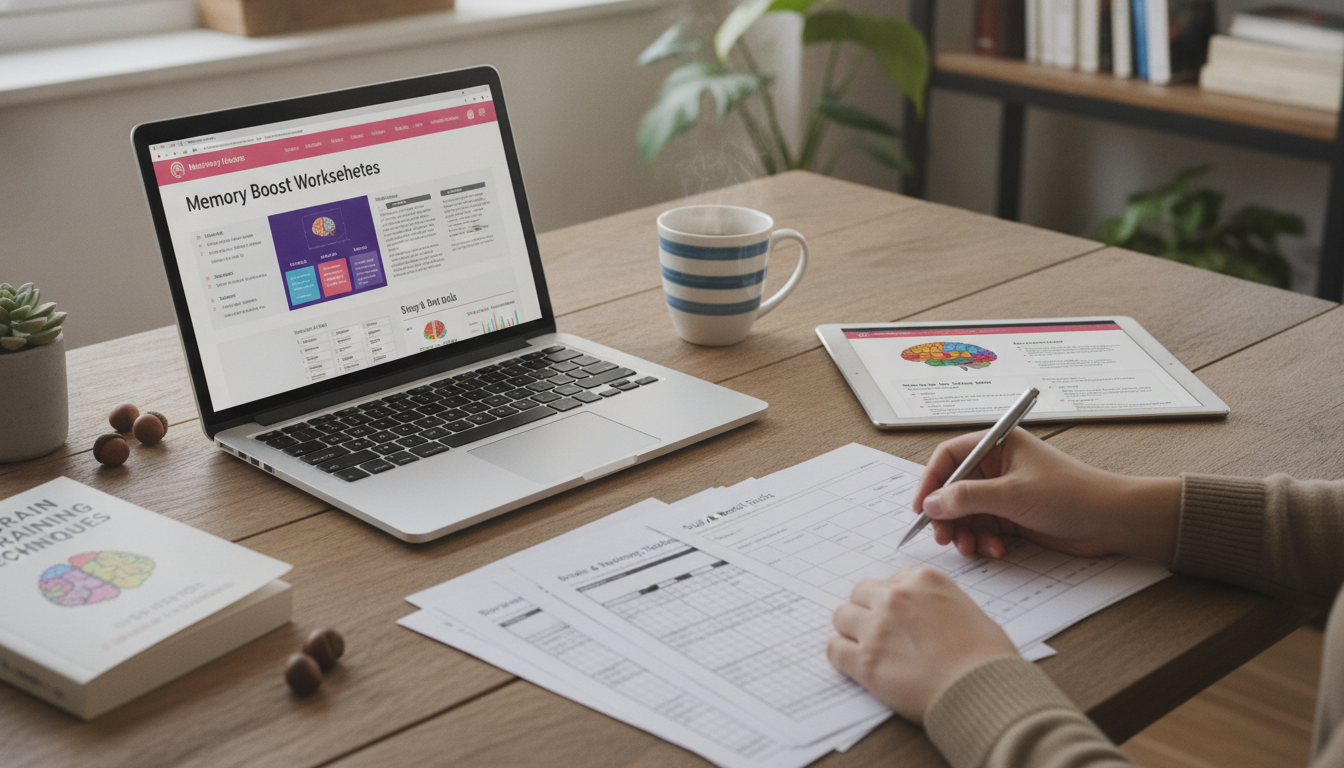
Why memory slips happen (and why worksheets help)
Forgetfulness usually isn’t a “bad memory” problem so much as a practice problem. A lot of missed details come from weak encoding (attention drifting), low organization (information stored without clear structure), and limited retrieval practice (not pulling answers out of memory often enough). When those three issues stack up, lectures blur together, names vanish mid-conversation, and test questions trigger that frustrating blank feeling.
Memory worksheets help because they create built-in prompts that force active thinking: summarizing ideas in your own words, sorting facts into categories, generating cues, and recalling information without looking. That repeated “pulling from memory” is a key ingredient in long-term learning.
They also reduce decision fatigue. Instead of constantly deciding what to study next or how to review, the format stays consistent—so more mental energy goes into remembering, not planning. Students get more exam-ready recall, and adults get sharper retention for work knowledge, courses, and everyday learning.
What’s inside a strong memory worksheet set
Not all brain training pages are equally useful. The most effective worksheet sets focus on recall and review systems that fit real schedules.
- Recall-first pages: prompts that make you answer before checking notes, so practice is based on retrieval (not rereading).
- Spaced review trackers: simple schedules that bring material back at increasing intervals.
- Chunking and organization templates: outlines, “big idea → details” frames, category grids, and mind-map style pages.
- Mnemonic builders: guided steps for acronyms, vivid imagery, and mini stories that stick.
- Reflection and error logs: quick spaces to record what was missed, why it was missed, and what cue will make it easier next time.
Printable vs digital: choosing the format that gets used
The “best” format is the one you’ll actually use consistently. Printables are great for distraction-free sessions and the handwriting effect—many learners remember better when they write and sketch. Digital worksheets shine for portability and easy duplication (especially for recurring review logs).
Format comparison for memory worksheet practice
| Need | Printable worksheets | Digital worksheets |
|---|---|---|
| Distraction control | High—paper keeps focus on the task | Variable—depends on device notifications |
| Ease of repetition | Requires reprinting or writing lightly | High—duplicate pages and reuse templates |
| Recall practice speed | Fast for quick drills and sketching | Fast for typed lists; slower for diagrams unless using a stylus |
| Tracking progress | Good with checkmarks and binders | Excellent with searchable logs and consistent naming |
| Best for | Students who like handwritten study and visual mapping | Adults and students who want portable practice and easy archiving |
A practical hybrid routine tends to be easiest: print key recall drills for focused sessions and keep spaced-repetition trackers digitally so nothing gets lost.
A simple 15-minute routine that builds recall
Memory improves when practice is short, repeatable, and slightly challenging. Try this quick structure several times per week:
- Minute 1–3: Choose one target (one chapter, lecture, meeting topic). Define “done” (example: recall 10 terms or explain 3 concepts).
- Minute 4–8: Active recall drill—answer prompts from memory first. Mark gaps without immediately checking notes.
- Minute 9–12: Fix-and-link—verify answers, then add one cue per missed item (image, keyword, category, or “why it matters”).
- Minute 13–15: Schedule the next review (tomorrow, 3 days, 7 days). Flag the toughest items for extra practice.
Students can finish with a mini teach-back paragraph (turn bullet notes into explanations). Adults can add a “real-life use” line (where this info will be applied) to strengthen retrieval cues.
Seven memory techniques students can practice (and adults can use too)
- Active recall: retrieve answers without looking—short prompts, questions, or blank-page summaries.
- Spaced repetition: revisit the same material over days/weeks with increasing intervals.
- Interleaving: mix related topics to improve flexible recall and reduce “false confidence” from blocked practice.
- Chunking: group items into meaningful sets (frameworks, categories, patterns) to reduce overload.
- Elaboration: add “why/how” explanations, examples, or connections to what you already know.
- Dual coding: pair words with visuals—simple diagrams, timelines, icons, or flowcharts.
- Mnemonics and imagery: acronyms, method of loci, and vivid mental pictures that make cues memorable.
For a deeper look at how memory forms and changes with attention and practice, see the American Psychological Association overview of memory. Everyday habits matter too—Harvard Health’s tips to improve memory and the NIMH guide to understanding sleep highlight how sleep and routine support recall.
Using memory worksheets for exams, professional learning, and everyday life
Recommended tools to pair with the worksheets
If attention and planning are the bigger bottleneck, pairing memory drills with a broader routine can help: Study Skills Mastery Guide | Digital Study Guide, Learning Strategies eBook, Focus Tips, Study Methods, Memory Techniques, Study Checklist PDF.
Memory Boost Worksheets: printable + digital practice in one download
If a ready-to-use structure would make practice easier, Memory Boost Worksheets for Students & Adults | Printable Digital Download | Brain Training eBook, Memory Techniques, Study & Recall Tools is designed for guided recall drills and repeatable brain-training exercises that work for both students and adults. Use it as a printable set for focused desk sessions, or keep it digital for portable practice and simple progress tracking.
FAQ
What are the 7 memory techniques for students to boost learning and recall?
Active recall (test yourself), spaced repetition (review on a schedule), interleaving (mix topics), chunking (group into meaningful sets), elaboration (explain why/how), dual coding (add visuals), and mnemonics/imagery (acronyms or vivid pictures) all improve recall by strengthening encoding and retrieval pathways.












Leave a comment