Stronger Together: Easy Family Bonding Routines
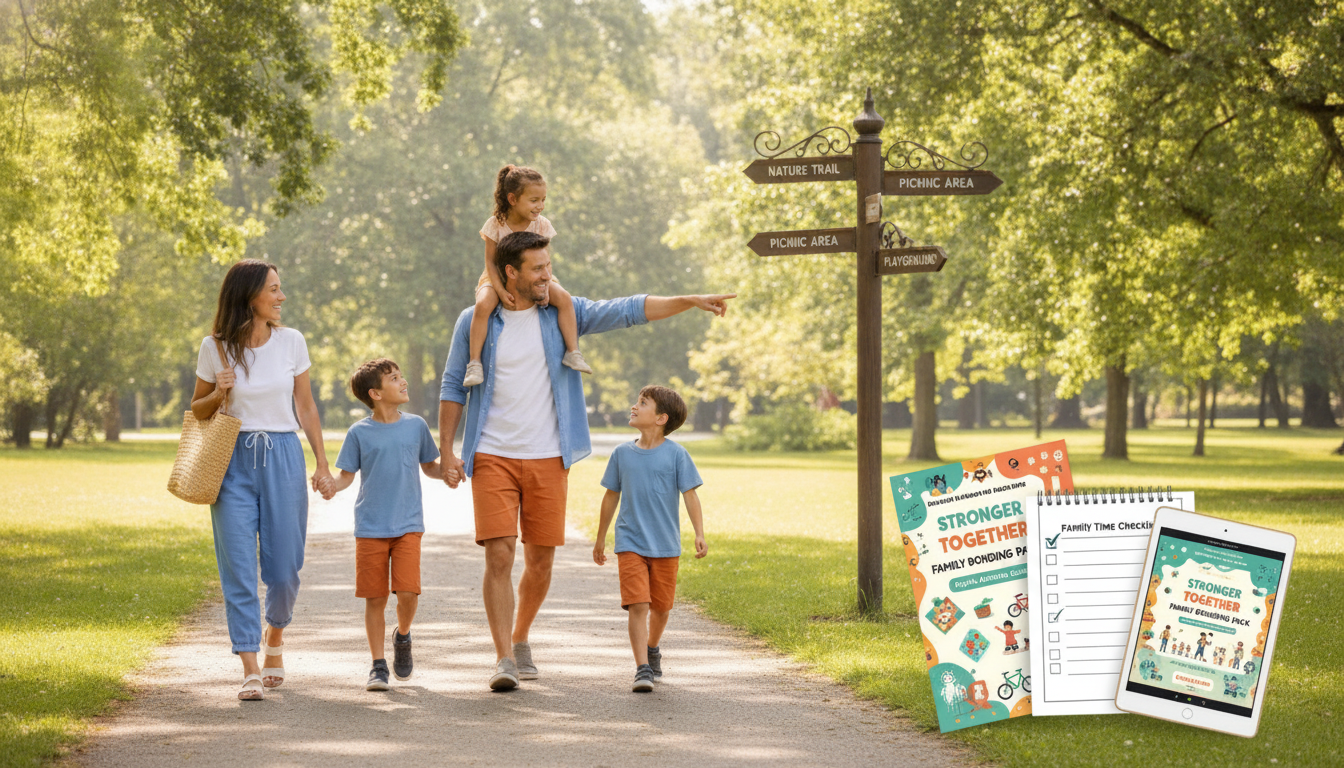
Stronger Together: Simple, Repeatable Ways to Build Family Connection at Home and Outside
Busy weeks, shifting schedules, and screens can make quality time feel harder than it should. A flexible set of quick activities—plus a simple checklist—can turn “someday” bonding into small, consistent moments that add up. This guide shares practical ways to use the Stronger Together: Family Bonding Pack to create routines kids actually enjoy, with options for indoors, outdoors, and low-prep days.
What’s Inside the Stronger Together Family Bonding Pack
The Stronger Together: Family Bonding Pack is a digital download made for parents and kids to do together. It’s designed to be easy to print, easy to start, and easy to repeat.
- Printable pages and guided prompts that work for quick connection or longer family time.
- At-home activities for calm days, rainy days, and short windows before bedtime.
- Outdoor activities for walks, parks, backyards, and neighborhood adventures—no special gear required.
- A family time checklist that helps you plan, track, and rotate activities without overthinking.
- eBook-style guidance to keep routines consistent, flexible across ages, and simple to reuse.
If screens have started to crowd out the little moments, it can help to pair your bonding rhythm with a clear media plan like the American Academy of Pediatrics Family Media Plan, so family time has a protected spot in the week.
A simple weekly rhythm that keeps bonding from falling off the calendar
Instead of aiming for one big “family night” that rarely happens, set a minimum dose goal: 10–20 minutes, 3–4 times per week. Small wins build trust—kids learn that connection is reliable, not occasional.
- Use the checklist like a menu: pick 1 indoor activity + 1 outdoor activity per week, then repeat them to build familiarity.
- Assign roles so kids feel ownership: “planner” (chooses), “helper” (sets up), “closer” (wrap-up prompt).
- Attach it to routines you already have: after dinner, right after school, or weekend mornings.
- Keep printables in a visible, grab-and-go spot (clipboard on the fridge or a slim binder).
Example weekly plan using the checklist
| Day/Window | Time | Activity type | Easy starter idea | Wrap-up prompt |
|---|---|---|---|---|
| Mon after dinner | 15 min | At-home | Family question jar + quick drawing | “What was one good moment today?” |
| Wed before bed | 10 min | At-home | Two-minute tidy + teamwork challenge | “How did we help each other?” |
| Sat morning | 30 min | Outdoor | Neighborhood scavenger hunt walk | “What did you notice that you never saw before?” |
| Sun afternoon | 20 min | Outdoor/At-home | Backyard games or living-room obstacle course | “What should we do again next week?” |
At-home activities that work on high-energy and low-energy days
Home connection works best when it matches the day you’re actually having. Keep a few “high-energy” and “low-energy” favorites ready so you’re not forcing a calm activity during wiggles—or a loud game when everyone’s fried.
- Low-prep connection: mini-interviews, silly would-you-rather questions, or a “tell me about your day” prompt with choices (best part / hardest part / funniest part).
- Hands-on teammate time: collaborative drawing, building challenges, or quick crafts where adults participate as partners, not judges.
- Calm-down bonding: read-aloud moments, cozy-corner chats, or simple breathing games that support regulation.
- Sibling-friendly formats: turn-taking plus shared goals (team score, team timer) reduces competition.
- Repeatability: pick 3–5 favorites and rotate them so connection becomes a tradition, not a one-off.
For easy read-aloud variety, pair family time with a rotating story night using the Educational Storybook for Growing Minds—one short story plus a single question afterward is often enough to spark meaningful conversation.
Outdoor connection activities that feel like play (not another task)
Outdoor bonding doesn’t need to be a production. A “micro-adventure” mindset—short, themed, and playful—makes it easier to start and easier to repeat.
These quick “back and forth” interactions mirror what child-development researchers call serve-and-return—responsive, shared attention that supports connection over time (see Harvard’s overview of Serve and Return).
Using the checklist to reduce decision fatigue and increase follow-through
Making it work across ages and attention spans
When emotions run high, simple, consistent structure helps—especially for toddlers and preschoolers. The CDC’s Essentials for Parenting offers practical guidance that pairs well with short, predictable connection routines.
Good moments to use the pack: holidays, transitions, and everyday stress
Quick start: set it up once, then reuse it all month
For families with older kids, adding one short “skill-and-celebrate” moment can make bonding feel more collaborative (set a tiny goal, practice together, then acknowledge effort). The Study Skills Mastery Guide can be a helpful add-on for quick, low-pressure routines like a 10-minute focus sprint followed by a shared break.
FAQ
Is this suitable for different ages in the same family?
Yes. Activities can be scaled up or down by shortening rounds for younger kids, adding responsibilities for older kids, and using roles (planner/helper/closer) so everyone participates without competing.
Do you need special supplies or a lot of prep time?
No—most activities use basic household items like paper, pens, tape, or chalk. The checklist supports 10–15 minute sessions, and an optional outdoor go-bag keeps “let’s go outside” simple.
How do you keep kids interested after the first week?
Repeat what works, rotate a small set of favorites, and let kids choose from pre-approved options. Ending on a high note—and tracking small wins on the checklist—makes the next session easier to start.











Leave a comment